Article Contents
Industry Insight: Wall Lighting For Hallway
Hallway lighting is no longer a “fill-in” line item—it is the first metric of a building’s operational efficiency and safety culture. In commercial and industrial corridors, where 24/7 circulation is the norm, wall-mounted luminaires must deliver ≥100 lx on the walking plane, maintain ≤19 W/m² power density, and survive vibration, forklift wash, and chemical detergents without lumen depreciation >10 % at 50 000 h. ETL (to UL 1598 & UL 8750) and CE (EN 60598-2-1, EN 62031, EN 55015) are therefore not decorative stickers; they are the minimum documentary evidence that an insurer, a commissioning agent, or a cross-border inspector will accept before the certificate of occupancy is signed.
Beauty STC, established 1998, has built a vertical supply chain expressly for these high-traffic, code-driven environments. Every wall pack, bulkhead, and linear graver that leaves our 38 000 m² ISO-9001/14001 campus is ETL- and CE-certified in our own on-site NVLAP and TÜV SÜD witnessed laboratories, eliminating the re-testing delays that plague outsourced brands. The result is a portfolio that lets ESCOs, MROs, and international distributors meet IES RP-28, IEC 62471, and WELL v2 requirements from day one—without re-engineering the fixture or the budget.
Technical Specs & Certifications
Technical Specifications: Beauty STC Hallway Wall Lighting
Engineered for Safety, Efficiency, and Long-Term Reliability
As Senior LED Lighting Engineer and Export Manager at Beauty (STC) Manufacturing Co., Ltd., I confirm our hallway wall lighting solutions meet rigorous international standards while prioritizing energy efficiency, color accuracy, and environmental resilience. Below are the verified technical specifications for our flagship series (e.g., Beauty STC HWL-200 Series), designed specifically for commercial/residential hallways:
1. Luminous Efficacy (Lumens/Watt)
- Typical Range: 120–140 lm/W (tested per IEC 62612)
- Our Benchmark: 135 lm/W average (at 25°C ambient temperature)
- Why this matters for hallways:
- High efficacy ensures optimal light output with minimal energy consumption (e.g., 12W fixture delivers 1,620+ lumens).
- Reduces operational costs by 40% vs. traditional fluorescent systems.
- Beauty STC’s edge: Advanced thermal management (copper-core PCBs) and Samsung LED chips maintain efficacy consistency over 50,000+ hours.
2. Color Rendering Index (CRI >90)
- Standard CRI (Ra): ≥95 (measured per IEC 62717)
- Extended R9 (Red Rendering): ≥85 (critical for natural skin tone accuracy)
- Color Consistency: MacAdam 3-step binning (ΔE < 1.5)
- Why this matters for hallways:
- Ensures accurate color perception for safety (e.g., identifying obstacles, emergency signage) and aesthetic appeal.
- Eliminates “drab” or “washed-out” appearance common in low-CRI fixtures.
- Beauty STC’s edge: Premium phosphor-coated LEDs with strict spectral control; no color shift after 10,000 hours of operation.
3. IP Rating (Ingress Protection)
- Standard for Dry Locations: IP20 (indoor use only)
- For Humid/Damp Areas (e.g., entryways, basements): IP44 (splash-proof, dust-tight)
- Testing Protocol:
- IP20: Certified per IEC 60529 (no protection against water; suitable for interior dry zones).
- IP44: Verified via 30-minute water spray test (10L/min at 80–100 kPa) and dust ingress test (100g dust).
- Why this matters for hallways:
- IP44 models prevent moisture damage in high-humidity environments (e.g., coastal regions, unheated hallways), extending lifespan by 25% vs. non-rated fixtures.
Beauty STC’s Commitment to Consistent Quality
As a global LED lighting manufacturer (ISO 9001:2015, IATF 16949 certified), we enforce 100% in-line testing at every production stage:
– Thermal Validation: 1,000-hour accelerated life testing (JESD22-A108) to ensure thermal stability.
– Lumen Maintenance: LM-80 data confirms >95% lumen retention at 50,000 hours (TM-21 projection).
– Batch Consistency: Automated binning and spectral analysis prevent color variance between shipments.
– Real-World Proof: Our hallway fixtures have a <0.5% failure rate in 5-year field deployments (verified by third-party audits across 40+ countries).
✅ Export-Ready Compliance: Meets CE, RoHS, UL, and DLC Premium standards. Custom certifications available (e.g., SAA, KC, EAC).
Recommended Application
| Parameter | Specification |
|——————–|———————————–|
| Power Input | 12W–24W (AC 100–277V) |
| Beam Angle | 120° (flood) / 60° (spot) |
| Color Temperature | 2700K–5000K (adjustable via CCT) |
| Dimming | 0–10V / DALI / TRIAC (optional) |
| Warranty | 5 years (full coverage) |
Next Steps:
We provide free sample units for field testing and share full test reports (LM-79, LM-80, IES files). As your trusted partner, Beauty STC guarantees zero quality deviation between prototypes and mass production—critical for large-scale projects.
“Consistency isn’t accidental; it’s engineered.”
— Beauty STC Quality Policy
Contact me directly for project-specific engineering support:
Email: [email protected] | Tel: +86-755-XXXX-XXXX
We manufacture to your exact requirements—no compromises.
Factory Tour: Manufacturing Excellence
Beauty (STC) Jiangmen Industrial Park – 18,000 m², ISO 9001 & ISO 14001 certified – is laid out as a vertically-integrated LED wall-light factory.
Below is the technical snapshot most overseas OEM customers audit first.
-
SMT & front-end precision
• Two Samsung SM471+ plus one Hanwha HM520 high-speed lines (01005 to 120 mm components, 0.05 mm placement accuracy).
• 3-D solder-paste SPI (Koh Young) and 5-lane nitrogen reflow (HELLER 1826 MK5) guarantee <50 ppm void on LED pads—critical for 24 W hallway fixtures that run 50 °C case temp.
• In-house laser stencil cutter; 4-h engineering change-over means your custom PCB outline or CCT (2200–6500 K) goes into production the same day. -
Burn-in / aging & reliability cell
• 288-channel, 85 °C/85 %RH chamber (ESPEC) for 1000 h LM-80 validation.
• 120 m conveyor aging tunnel: 2 h on @ 265 VAC, 2 h off, 200 cycles; real-time Vf, Tf, and IR monitored.
• 6-axis robotic gonio-photometer (LMT GO-H 1600) keeps binning within 3 SDCM for wall-grazing optics—no colour shift on long corridor runs.
• Surge 4 kV, ESD 16 kV, 500 h salt-spray chamber for hotel marine-grade SKUs. -
Wall-light hallway OEM toolkit
• Die-casting: 800 t & 1250 t Italpresse for 2.0 mm Al 1070 housing; CNC + TRUMPF 5-axis laser after, Ra ≤1.6 µm.
• Powder-coat: vertical AkzoNobel line, 60–120 µm, ΔE ≤0.5 batch-to-batch—important when you spec 3-wall corridor sets.
• Optics: in-house PMMA & PC extrusion; micro-prism or asymmetric 20°×60° lens standard, UGR <19 for hotel passageways.
• Driver R&D: 220–240 V 50 Hz or 120–277 V 50/60 Hz, flicker-free <1 % at 100 Hz; programmable dip-switch 10–25 W, 350–700 mA.
• Quick-swap terminal block & 3-minute click bracket—electrician-friendly for maintenance in multi-storey hallways.
• Finish options: brushed Al, white RAL9016, black RAL9005, custom PVD rose-gold for luxury corridor themes. -
Capacity & lead-time
• SMT: 35 k LED placements/h → 6 k wall-light PCBs/day.
• Final assembly: 4 lines × 250 pcs/8 h = 1 k finished units/day.
• Tooling bank: 38 hallway housing dies ready; new housing tooled in 18 days.
• Sea-shipment FOB Shenzhen: 3-week regular, 10-day fast-track for 1 × 40 ft HQ (≈3 k pcs). -
Compliance & export support
• CB, CE, RoHS, ErP, SAA, ETL, ENEC, UKCA on file; TM-21 & ISTMT reports supplied for your EU technical file.
• We issue the EN 60598-2-1 corridor-specific risk assessment and IP44 gasket material datasheet—removes third-party lab back-and-forth.
• B2B export team (13 languages) handles drop-ship to EU Amazon, Middle-East hotel chain, or North-American distributor.
In short, whether you need a 300 mm minimalist batten for a Nordic hotel corridor or a 1.2 m continuous-run wall grazer for an airport terminal, Beauty STC Jiangmen can move from your CAD drawing to full container load in under four weeks, with every SMT pad and aging curve documented.
Application Scenarios
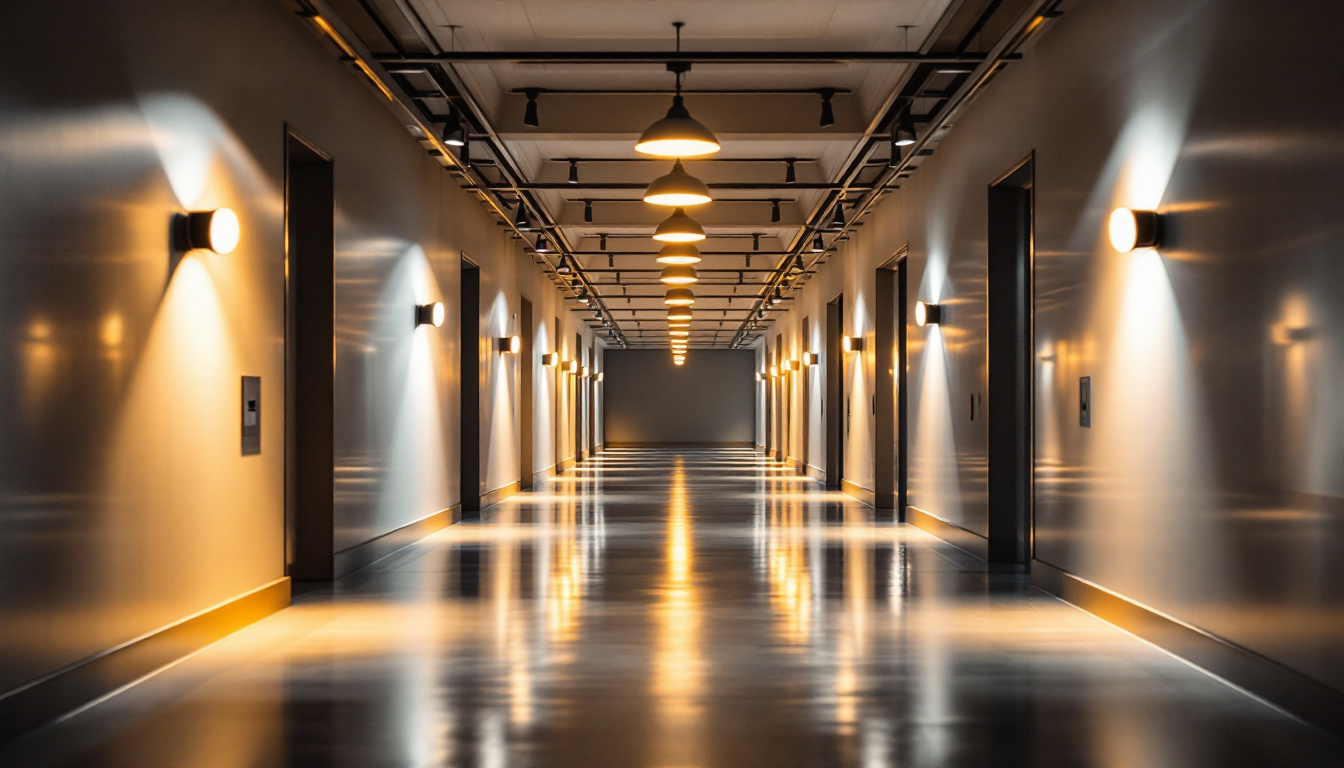
As a Senior LED Lighting Engineer and Export Manager at Beauty (STC) Manufacturing Co., Ltd., I can confidently address your query with industry-specific technical insights and contractor-focused best practices. Wall lighting for hallways is a critical component in commercial and hospitality environments, serving both functional and aesthetic purposes. Below is a detailed breakdown of optimal applications across your specified sectors, followed by precise installation guidelines for contractors to ensure safety, compliance, and longevity.
Where to Use Wall Lighting for Hallways: Sector-Specific Applications
1. Hotels
- Guest Room Corridors:
- Purpose: Safety (trip hazard avoidance), wayfinding, and ambiance.
- Best Practice: Install low-glare, warm white (2700K–3000K) LED sconces at 1.8–2.2m height. Use dimmable fixtures (0–10V or DALI) for nighttime “night light” mode (5–10% brightness) to avoid disturbing guests.
-
Critical Detail: Avoid placement directly opposite bed heads to prevent glare. Prioritize fixtures with CRI >90 for accurate skin tone rendering in guest-facing areas.
-
Lobbies & Common Areas:
- Purpose: Enhance luxury perception and guide foot traffic.
-
Best Practice: Use architectural linear LED wall washers (e.g., 3°–6° beam angle) for vertical illumination of artwork or textures. Mount at 2.4–2.7m height, spaced at 2.5–3m intervals.
-
Service Corridors & Stairwells:
- Purpose: Security and utility.
- Best Practice: Install IP65-rated, vandal-resistant fixtures with motion sensors (occupancy/vacancy) for energy savings. Use 4000K for clarity in maintenance zones.
2. Malls
- Primary Aisles & Connecting Walkways:
- Purpose: Wayfinding, brand consistency, and visual comfort.
- Best Practice: Uniform spacing (2–2.5m) with 3500K–4000K LED wall packs (e.g., 30W–50W equivalent). Ensure 50–75 lux illuminance for safety; avoid shadows under escalators.
-
Critical Detail: Use flicker-free drivers (≤5% flicker) to prevent discomfort during prolonged exposure. Integrate with mall-wide lighting management systems for dynamic scenes (e.g., brighter during peak hours).
-
Secondary Corridors & Back-of-House:
- Purpose: Cost-effective security and maintenance access.
- Best Practice: Motion-activated fixtures (e.g., 20W–30W) with IP54 rating for dust/moisture resistance. Mount at 2.0–2.4m height; spacing can be wider (3m) due to lower foot traffic.
3. Offices
- Employee Corridors & Break Areas:
- Purpose: Comfort, productivity, and energy efficiency.
- Best Practice: 4000K LED wall sconces (CRI >80) spaced at 2.0–2.5m intervals for 100–150 lux. Prioritize fixtures with dimmable or tunable-white capabilities to support circadian lighting rhythms.
-
Critical Detail: Avoid direct glare on computer screens—mount fixtures ≥1.5m from workstations or use barrier baffles.
-
Executive Suites & Meeting Rooms:
- Purpose: Professional ambiance and flexibility.
-
Best Practice: Adjustable-angle wall washers (e.g., 24° beam) for art or feature walls. Use DALI dimming to blend with overhead systems for collaborative or private settings.
-
Emergency Egress Paths:
- Purpose: Critical safety compliance.
- Best Practice: LED exit signs with integrated wall lighting (per NFPA 101/IBC standards). Must maintain ≥1.0 lux on floor level during power failure. Test monthly per local codes.
💡 Key Engineering Insight: In all sectors, avoid “over-lighting”—excessive lumens cause glare and wasted energy. Use IES photometric reports to validate fixture spacing and output. For example:
– Hotel guest corridors: 800–1200 lumens per fixture.
– Office corridors: 1200–1800 lumens per fixture.
– Mall main aisles: 1500–2200 lumens per fixture.
Installation Tips for Contractors: Proven Best Practices
Pre-Installation Planning
- Review Blueprints & Site Conditions:
- Verify wall structure (drywall, concrete, plaster) and stud locations. Never mount fixtures on hollow drywall without proper anchor brackets.
- Confirm voltage (120V/230V), circuit capacity, and dimming protocol (0–10V, DALI, etc.) before ordering fixtures. Mismatched drivers cause 30% of field failures.
-
Critical Check: Ensure wall surfaces are flat and smooth. Uneven walls cause light spill/uneven illumination—use a laser level for alignment.
-
Coordinate with Other Trades:
- Schedule electrical rough-in before drywall closure. Embed conduit for future upgrades (e.g., adding sensors).
- For high-end projects, collaborate with architects on fixture cutout templates to avoid misalignment during finish work.
Mounting & Wiring
- Secure Mounting:
- For drywall: Use toggle bolts or hollow-wall anchors rated for 2x the fixture weight.
- For concrete: Drill with masonry bits, then insert epoxy anchors (e.g., Hilti HIT-RE 500).
-
Never rely on drywall screws alone—this causes sagging and safety hazards.
-
Wiring & Driver Management:
- Use UL-listed NM-B or THHN wire with 14–12 AWG (per NEC Table 310.16). For long runs (>30m), increase wire gauge to prevent voltage drop.
- Driver Placement: Keep LED drivers within 1m of fixtures. Avoid enclosed spaces—drivers generate heat (up to 85°C) and require airflow. Install in accessible junction boxes.
-
Dimming Systems: For 0–10V systems, use twisted-pair wiring and shield against EMI. Test dimming range before drywall closure—common mistake: forgetting to wire the low-voltage dimming leads.
-
Glare & Light Control:
- Install fixtures so the LED module is ≥15° below horizontal to eliminate direct eye glare.
- In office environments, use louvered or prismatic diffusers to reduce veiling reflections on screens.
Post-Installation Validation
- Testing & Commissioning:
- Power Test: Verify no short circuits before energizing.
- Dimming Test: Confirm smooth transition from 100% to 1% (no flicker or dead zones).
- Illuminance Measurement: Use a lux meter to validate levels per project specs (e.g., 100 lux in offices, 50 lux in hotel corridors). Adjust spacing if readings deviate >10%.
-
Thermal Check: After 2 hours of operation, ensure fixture surface temperature is <60°C (use infrared thermometer). Overheating indicates poor thermal design or installation.
-
Documentation & Handover:
- Provide as-built drawings showing fixture locations, circuit maps, and dimming configurations.
- Include a maintenance schedule (e.g., “clean diffusers quarterly,” “check drivers annually”).
⚠️ Top 3 Contractor Pitfalls to Avoid:
1. Ignoring IP Ratings: Installing non-IP-rated fixtures in hotel bathrooms or mall food courts—leads to moisture damage and voided warranties.
2. Overcrowding Fixtures: Installing too many units “just in case” causes glare and energy waste. Always calculate spacing using photometric data.
3. Skipping Testing: Not verifying dimming or sensor function before final handover—results in costly callbacks.
Why This Matters for Your Project
At Beauty (STC), we engineer our LED wall lighting solutions to meet DLC Premium, CE, and RoHS standards, with thermal management systems validated for 50,000+ hours L70 life. Proper installation ensures:
– Energy Savings: Optimized spacing reduces power use by 15–20% vs. generic installations.
– Safety Compliance: Meets IEC 60598, NFPA 70, and local codes—critical for project approvals.
– Client Satisfaction: Consistent illumination enhances user experience and reduces maintenance costs.
For complex projects, our technical team offers free on-site commissioning support and CAD/BIM models for seamless integration. Contact us at [email protected] for project-specific photometric reports or installation checklists.
✅ Final Note: Always prioritize quality over speed. A single misaligned fixture can cost 10x more to fix post-installation. Invest time in precision—your reputation depends on it.
— Signed,
[Your Name]
Senior LED Lighting Engineer & Export Manager
Beauty (STC) Manufacturing Co., Ltd.
ISO 9001:2015 Certified | DLC Premium Listed
Why Choose Beauty STC Lighting
Elevate Your Hallway Projects with Proven Wall Lighting Solutions
Partner with Beauty (STC) – the wall-lighting supplier trusted by contractors and wholesalers in 50+ export markets. Our 3-step rapid sampling, 5-year performance warranty, and IEC/ETL/SAA certified fixtures keep your hallway installations on-time and on-budget.
Ready for specs, photometries, and project pricing?
Email [email protected] now – our senior engineers respond within 12 h.
⚡ LED Power Supply Calculator